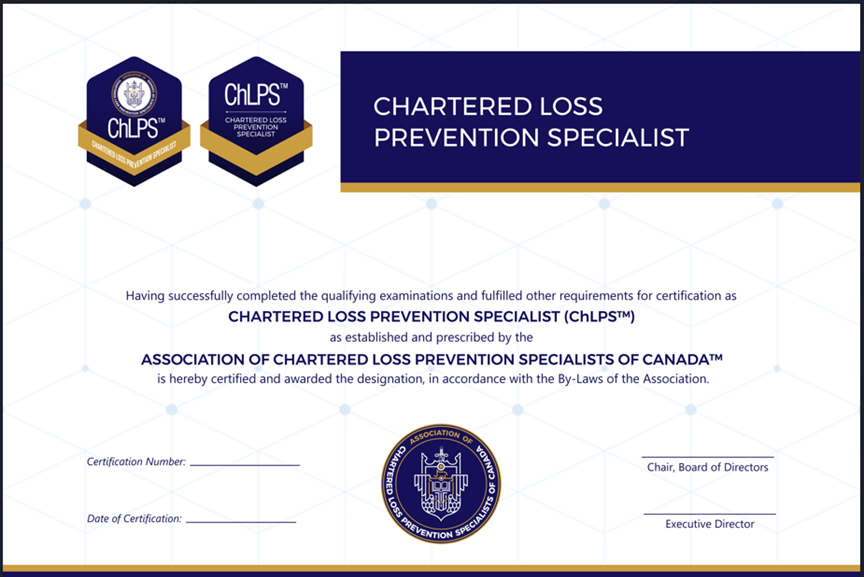
Chartered Loss Prevention Specialist (ChLPS™) Certification

Write your awesome label here.
The Chartered Loss Prevention Specialist certification (ChLPS™) is the highest professional designation offered by the Association of Chartered Loss Prevention Specialists of Canada. It is designed for seasoned leaders who manage complex loss prevention programs and influence organizational strategy. This advanced credential emphasizes strategic planning, executive leadership, and the specialized expertise required for senior roles in the field of loss prevention and corporate security.

Benefits and Opportunities

Elite professional designation for senior-level LP practitioners and consultants.
Recognizes mastery in strategy, governance, and enterprise-wide LP leadership.
Boosts career visibility for director and executive roles.
Access to chartered member privileges and advisory council roles.

Entry Requirements

  •   Must hold CLPM or equivalent advanced certification in loss prevention or corporate security.
  •   Minimum of 3 years of progressive experience in LP or corporate security.
  •   Completion of the Association Board Review Interview or Capstone Project Submission.
Empty space, drag to resize

ChLPS Program of Studies:

  •   Case Study 1: Enterprise Risk, Operational Breakdown
  •   Case Study 2: Retail and Supply Chain Shrinkage Investigation
  •   Case Study 3: Corporate Fraud, and Compliance Breaches
  •   Case Study 4: Critical Incident and Crisis Response
  •   Case Study 5: Security Program Evaluation and Redesign
  •   Module 6: Applied Capstone Research Project

Detailed Program of Studies for the ChLPS Certification

Certificate of Completion

Lorem Ipsum is simply dummy text of the printing and typesetting industry. Lorem Ipsum has been the industry's standard dummy text ever since the 1500s, when an unknown printer took a galley of type and scrambled it to make a type specimen book. It has survived not only five centuries,
Contrary to popular belief, Lorem Ipsum is not simply random text. It has roots in a piece of classical Latin literature from 45 BC, making it over 2000 years old.
Created with